Understand the need
Ask useful questions before suggesting an option.
Guide customers through your catalogue, clarify differences, and surface suitable options based on the needs they share.
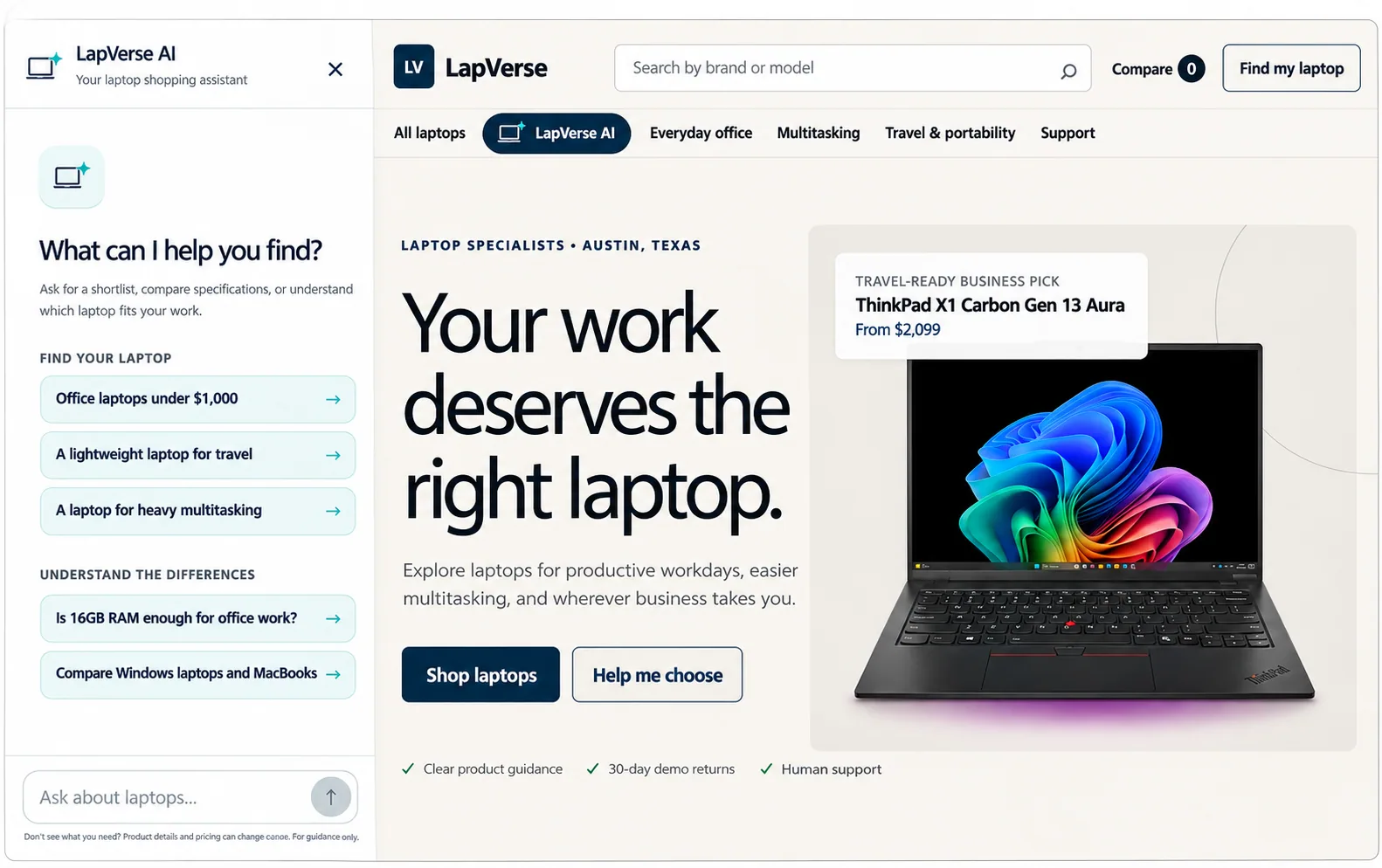
A provided example showing how an AI shopping assistant can understand a customer’s needs, explain options, and guide them toward a suitable product.
Rynx defines the assistant’s role, boundaries, information, exceptions, and handoff path before implementation.
Ask useful questions before suggesting an option.
Use approved product information structured for the project.
Help shoppers compare relevant attributes in plain language.
Point to the appropriate product page or human support path.
A shopper describes what they need.
The assistant asks clarifying questions and checks approved catalogue data.
It explains relevant options and guides the next action.
A client implementation for LapVerse in the United States with catalogue-grounded recommendations, follow-up memory, validation, and linked product cards.
Usage starts from the fixed INR base rates of ₹10 per voice minute and ₹3.20 per chat. UK and US usage is converted automatically using the displayed live reference rate; setup and monthly support remain fixed regional fees.
It can guide discovery based on approved catalogue information and rules defined for the project.
Yes, when reliable comparison attributes are available in the provided catalogue data.
Only if an approved, supported inventory connection is included in scope.
That depends on the commerce platform and the project’s approved integration scope.
Chat usage starts from the fixed ₹3.20-per-chat INR base rate. UK and US estimates use the live conversion displayed in the calculator; applicable provider charges are stated separately.
Recommendation boundaries and business rules can be defined during solution design.
Tell us what your team handles today. We’ll help define what should be automated, connected, or handed to a person.